

2026 Tours and Excursions from Piano Provenzana
Piano Provenzana is the departure point for Etna North excursions.
Available excursions:
- 4x4 Tour + Trekking to the 2002 Craters at 3,000m — from €69
- Sunset Excursion by 4x4 on the volcano — from €79
- Guided trekking to Valle del Bove, Pizzi Deneri Observatory, North-East Rift — from €100
- Summit Craters at 3,403m with volcanological guide — from €130
Daily departures with authorised volcanological guides. Compare and book all excursions.
What is Piano Provenzana
Piano Provenzana is a tourist station located at 1,800 metres altitude on the northern slope of Mount Etna, in the territory of the municipality of Linguaglossa (province of Catania, Sicily). It is reached via the provincial road SP 59-II (Via Mareneve), which starts from Linguaglossa and crosses the Ragabo Pine Forest, the highest pine forest in Sicily. From Catania it takes about 1h30 by car, from Taormina 1h15: full directions for car, bus, transfer and airport are in our how to reach Piano Provenzana guide.
It is the main access point to the northern side of the volcano and the starting base for guided excursions to the 2002 lateral craters, the summit craters, Valle del Bove and the Pizzi Deneri Observatory. Unlike the southern slope (Rifugio Sapienza), Piano Provenzana receives fewer visitors and offers a more natural environment: recent lava flows, high-altitude beech forests and panoramas of the Ionian coast all the way to Calabria.
For the current state of volcanic activity and updated INGV bulletins see the latest Etna eruption page. Before leaving you can check the live webcams and weather forecast for the northern slope.
Altitude of Piano Provenzana
Piano Provenzana sits at 1,800 metres above sea level (a.s.l.), on the northern slope of Mount Etna. It is the highest tourist station on the northern side of the volcano directly reachable by car via the Mareneve road — for detailed directions from Catania, Taormina and Airport see the how to get there guide.
From Piano Provenzana guided excursions continue in 4x4 vehicles up to the 2002 lateral craters (2,100 m), the panoramic point at 3,000 metres and the Pizzi Deneri Observatory (2,800 m). Only with trekking and an authorised volcanological guide is it possible to reach the summit craters at 3,403 metres, the peak of Etna and the highest point in Europe among active volcanoes.
What to See at Piano Provenzana and Around
Piano Provenzana and the surrounding area host unique volcanic, natural, and historical attractions. Etna's northern slope is the least developed of the volcano's four sides: fewer tourists, more silence, panoramas stretching from the summit craters to the Ionian Sea, all the way to Calabria.
On Site
- 2002 eruption craters: lava desert reachable on guided 4x4 excursions, direct evidence of the event that destroyed the station.
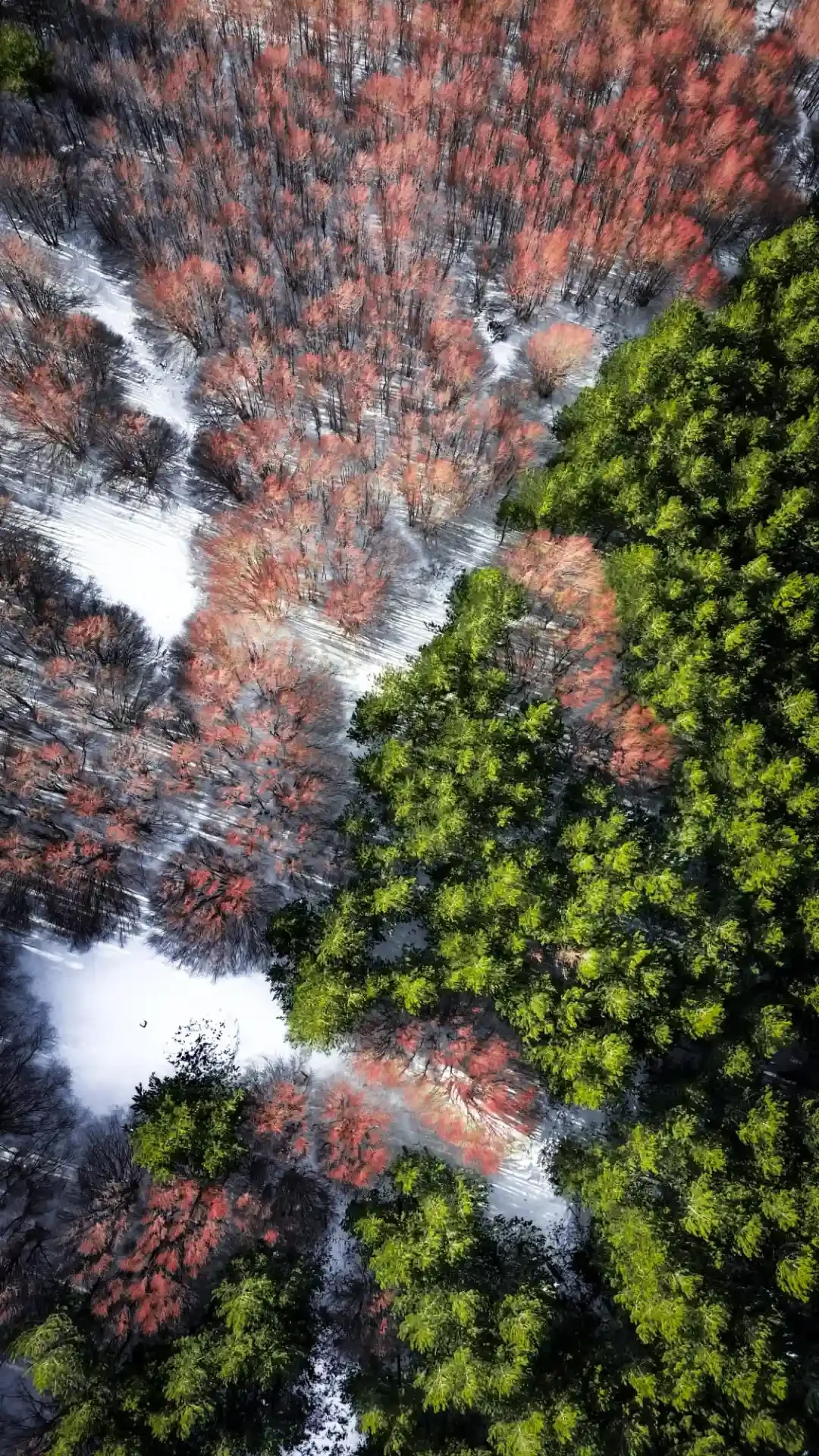
- Ragabo Pine Forest: the highest pine forest in Sicily (1,500-2,000 m), with Laricio pines used since Roman times.
- Rifugio Timparossa: historic mountain hut nestled in the beech forest, a key reference for hikers.
- Panoramic view: a sweeping panorama from the main crater to the Ionian Sea, Taormina, and — on clear days — Calabria.
Around Etna North
- Monti Sartorius: 7 small craters lined up, formed by the 1865 eruption. Easy loop trekking through the pine forest.
- Valle del Bove: enormous natural amphitheatre (about 7 km × 5 km), formed by the collapse of the ancient Trifoglietto volcano. One of the most spectacular areas of Etna, reachable on guided excursions to Valle del Bove.
- Pizzi Deneri Observatory: volcanological station at 2,800 metres, reached by guided trekking. Privileged view of the summit craters.
- Volcanic caves: the Grotta del Gelo (the highest in Europe, with a permanent glacier) and Grotta delle Palombe, formed by lava flow.
- Pista Altomontana: about 40 km of trail crossing the northern slope at 1,700 m, through Etna's beech forest.
Tours and Excursions from Piano Provenzana
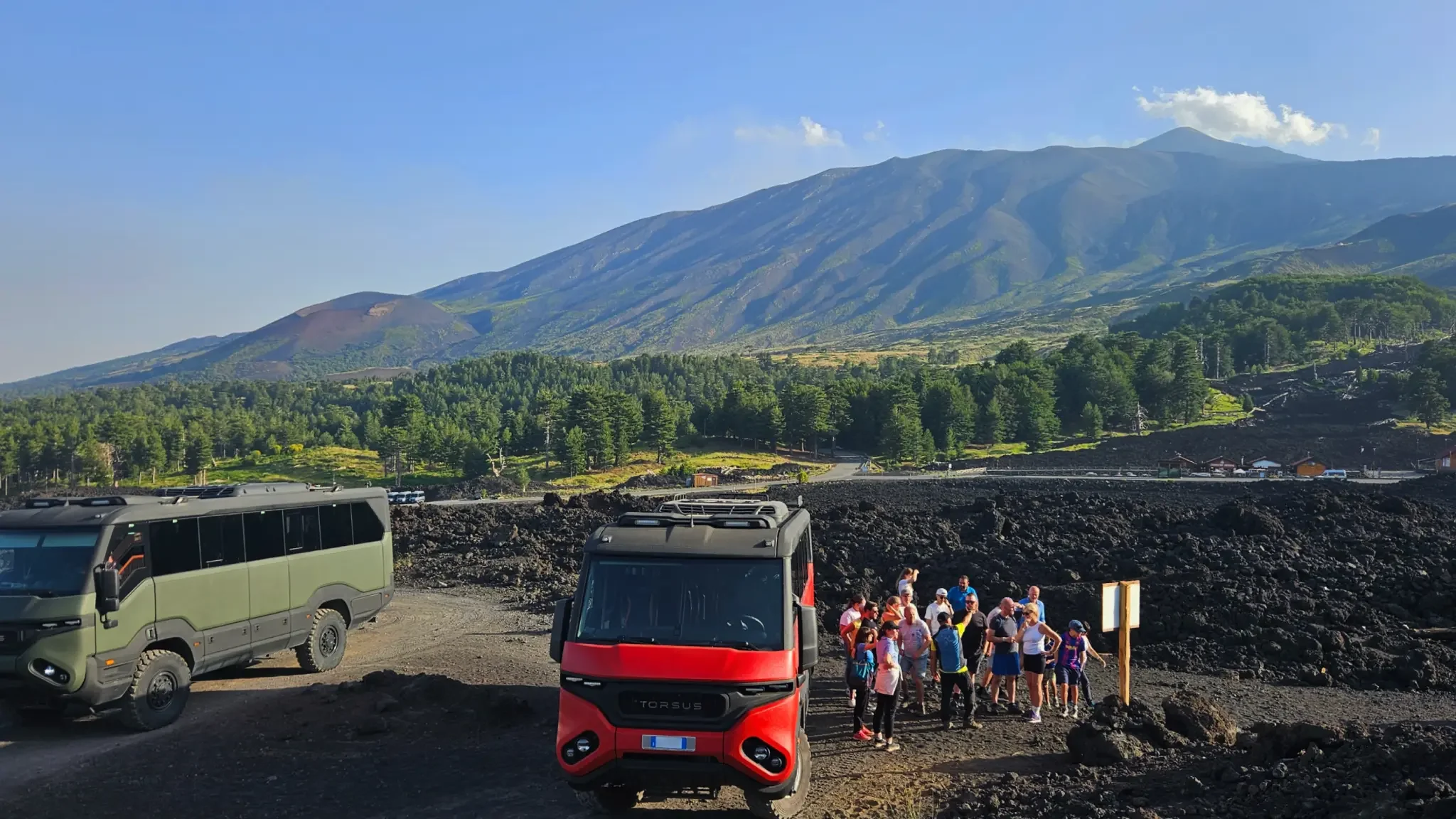
From Piano Provenzana depart all the guided excursions of Etna's northern slope. Excursions use 4x4 vehicles to overcome the elevation up to the lateral craters (3,000m), and continue with guided trekking where roads do not reach.
Most popular excursions:
- 4x4 Tour + Trekking to the 2002 Craters (from €69) — the most booked: 4x4 ascent along the 2002 lava flow, stop at the lateral craters at 2,100m, panoramic continuation up to 3,000m with views of the summit craters.
- Sunset Excursion (from €79) — evening 4x4 tour with sunset over Etna and views of the Ionian Sea. Ideal for couples and photographers.
- Trekking to the Summit Craters (from €130) — full ascent up to 3,403m, the peak of Etna, with an authorised volcanological guide.
- Trekking to Pizzi Deneri Observatory (from €120) — high-altitude itinerary up to the volcano observation station (2,800m).
- Trekking in Valle del Bove (from €100) — descent into Etna's natural amphitheatre, through the Serracozzo Cave.
- Trekking to the North-East Rift (from €100) — the 2002 eruption site seen from inside.
- Private Jeep Tour (from €100) — private personalisable experience, with optional pickup from Catania or Taormina.
In case of an active eruption, a guided excursion to the lava front in Valle del Bove is available with BÙUM volcanological guides.
See all excursions and book online →
The 27 October 2002 Eruption: History and Memory
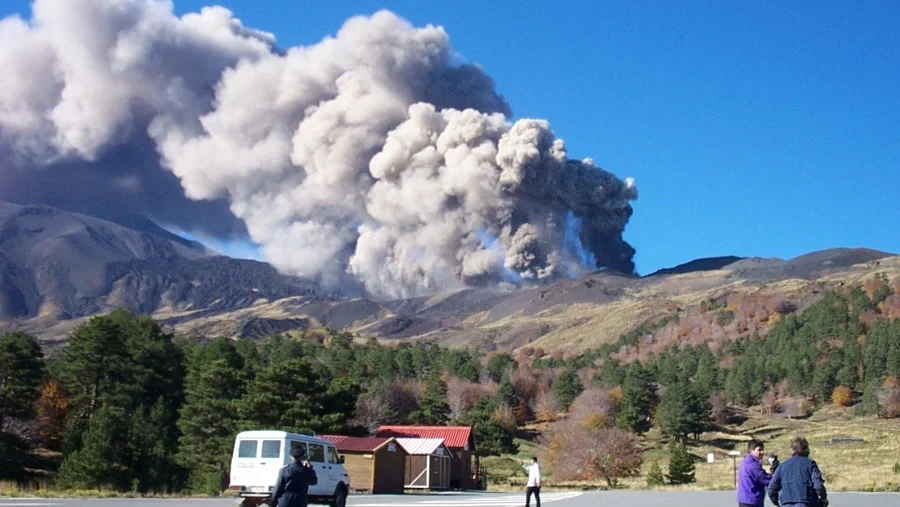
The 27 October 2002 eruption is the most significant chapter in Piano Provenzana's recent history. Known among scholars as "the perfect eruption", it opened a "buttonhole" of eruptive vents along the North-East Rift, one of the most important fracture systems on the slope.
Timeline:
- 27 October 2002: first eruptive fissures open at 2,500 m altitude. Lava begins flowing northwards.
- Night of 27-28 October: the lava flow reaches Piano Provenzana, destroying hotels, mountain huts and all then-existing tourist infrastructure.
- First 10 days: the flow advances about 13 km towards Linguaglossa, stopping before reaching the village.
- January 2003: the eruption ends after 94 days.
The rebirth: after the destruction, Piano Provenzana was progressively rebuilt. Today the 2002 "lava desert" can be visited with 4x4 excursions and is one of Etna's most relevant geological attractions: few places in the world allow walking on a recent, perfectly preserved lava flow.
The Origins of the Tourist Station
Piano Provenzana's history as a tourist station dates back to the early 20th century:
- 1919: Linguaglossa's mayor Francesco Castrogiovanni proposed valuing the forest and panoramas of the northern slope.
- 1947: works begin on the Mareneve road, on the initiative of Hon. Attilio Castrogiovanni.
- 1972: Commissioner Angelino Emmi signs the decision for the final connection up to Piano Provenzana, completing the road that today still connects Linguaglossa to the tourist station.
Plan Your Visit
Piano Provenzana offers different experiences each season. For updated forecasts and month-by-month temperatures see our Etna weather guide. For schedules, transport and detailed routes go to our connections guide.
What to bring (high-altitude excursions, even in summer):
- Layered clothing (it gets cool at 3,000m even in summer)
- Trekking shoes
- Hat, sunglasses, sunscreen
- Water and energy snacks
- Camera